Product Introduction
Environmental science researchers and educators face a persistent challenge: sampling airborne particulates and gaseous pollutants simultaneously typically requires deploying two or more separate instruments, each with its own pump, power supply, calibration routine, and data management workflow. This multi-instrument approach increases equipment costs, complicates field logistics, and introduces inter-instrument variability that can compromise data comparability. In university teaching laboratories, limited budgets and bench space make it impractical to maintain dedicated particulate samplers alongside gaseous pollutant sampling stations, forcing compromises in curriculum design and student hands-on experience.
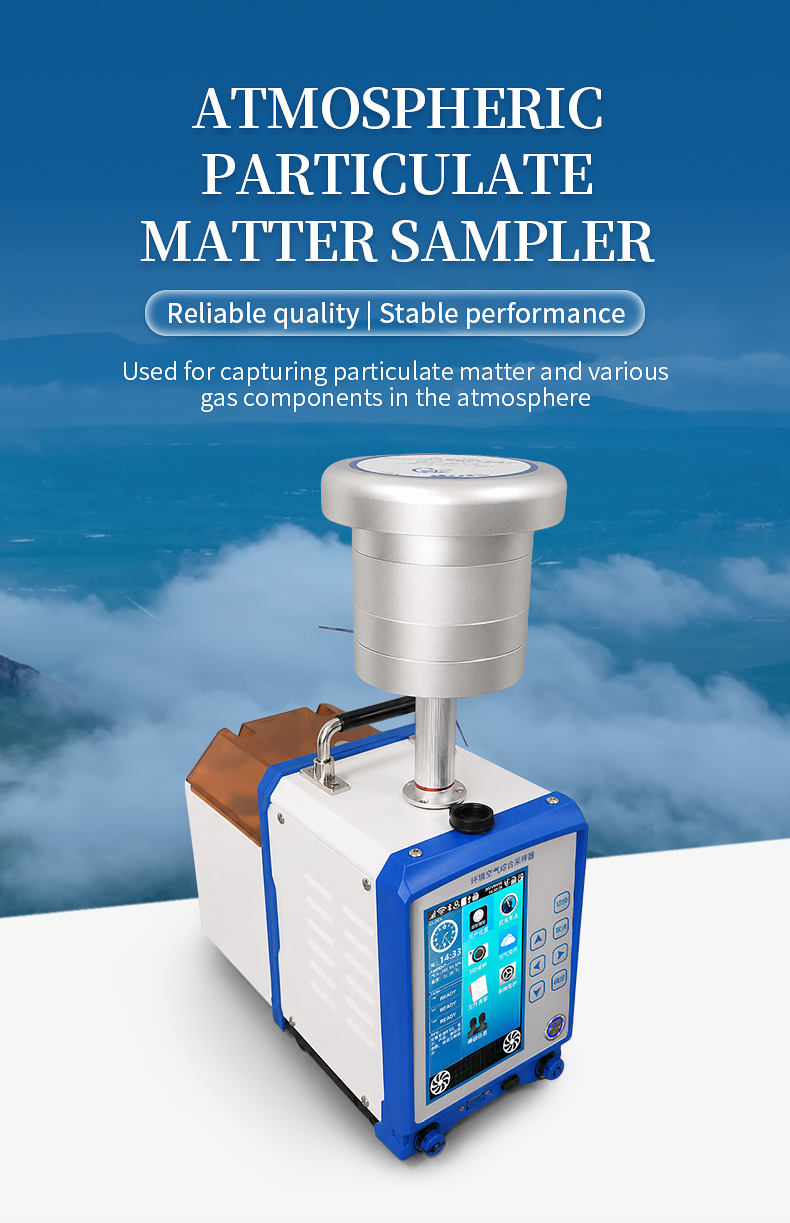
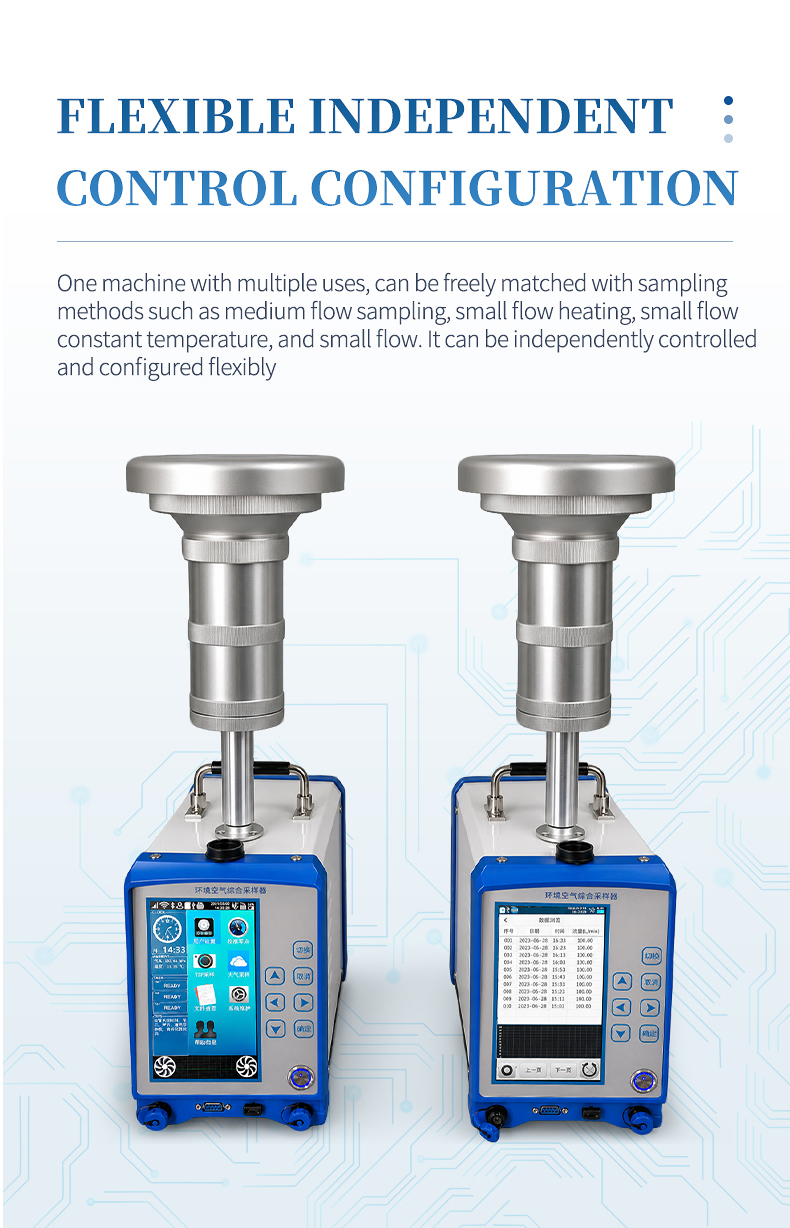
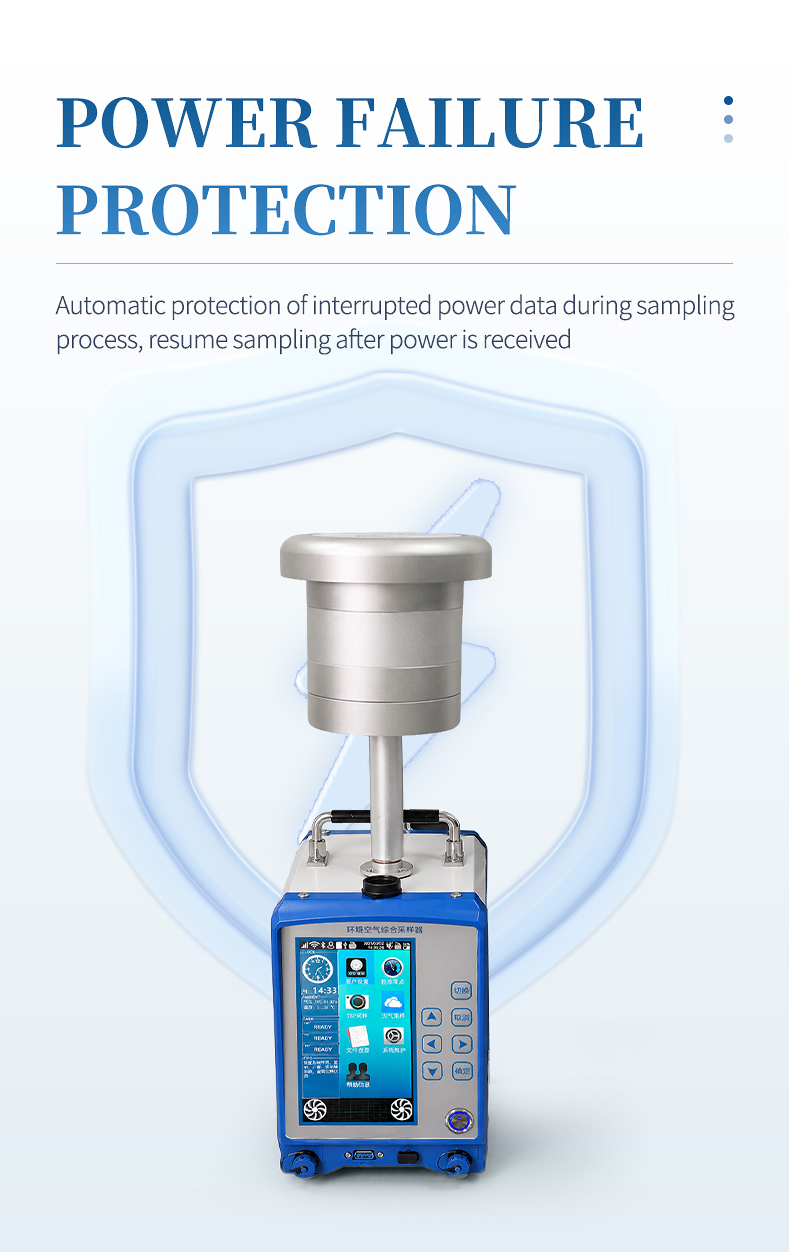
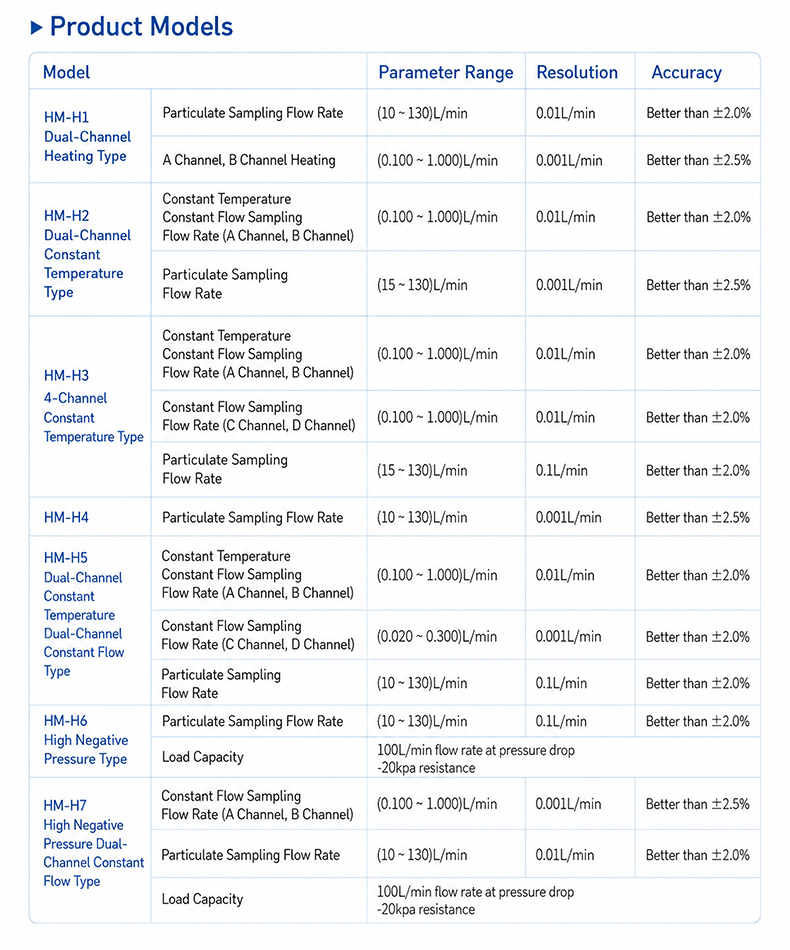
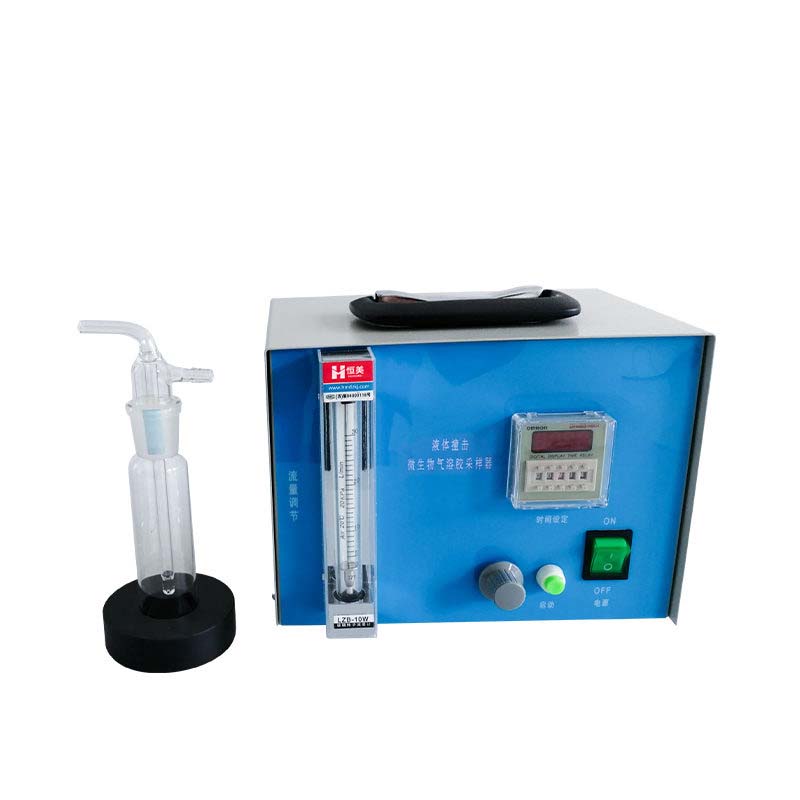
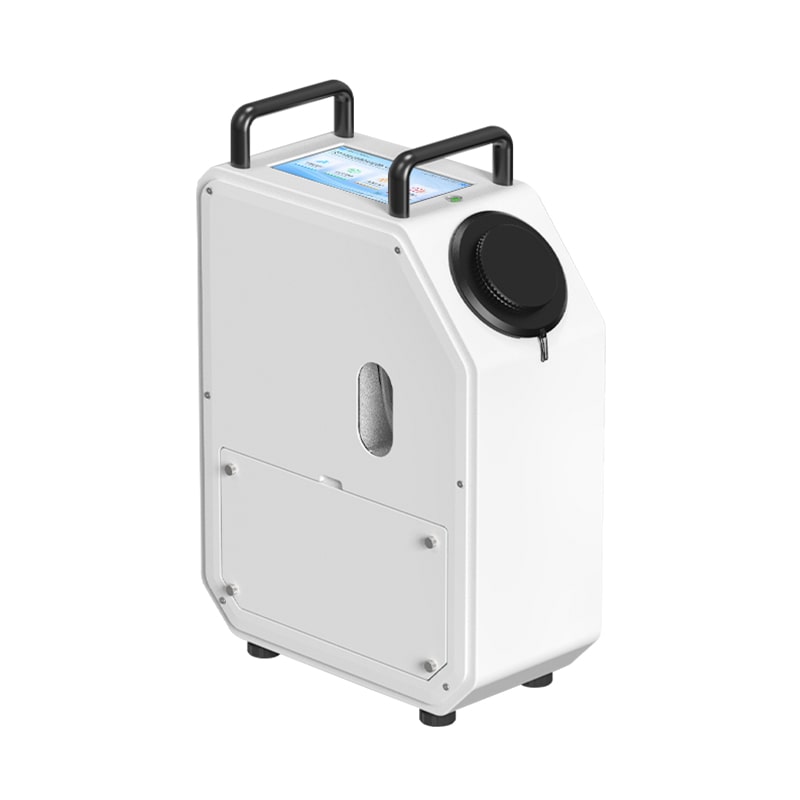
The HM-H5 enhanced comprehensive air sampler from HM Instruments addresses these constraints by integrating three independent sampling channels into a single 165×330×275 mm instrument weighing approximately 4.0 kg. A constant-temperature constant-flow channel accommodates traditional absorption-bottle methods for SO2, NOx, and other gaseous pollutants. A micro-flow constant-flow channel operating at 0.020–0.300 L/min is specifically designed for VOCs sorbent tube sampling, enabling volatile organic compound collection at the low flow rates required by standard methods such as EPA TO-17 and HJ 644-2013. A particulate sampling channel delivers 10–130 L/min with accuracy better than ±2.0%, supporting TSP, PM10, and PM2.5 size-selective sampling. All three channels operate independently with separate flow control, allowing researchers to configure each channel according to specific method requirements without cross-channel interference. Automatic measurement of pre-gauge temperature, pre-gauge pressure, and atmospheric pressure ensures that standard-condition sampling volumes are calculated in real time, eliminating post-processing corrections. At $971, the HM-H5 provides research laboratories and educational institutions with a cost-effective, space-efficient alternative to multi-instrument setups without sacrificing measurement accuracy or method compliance.
Applications
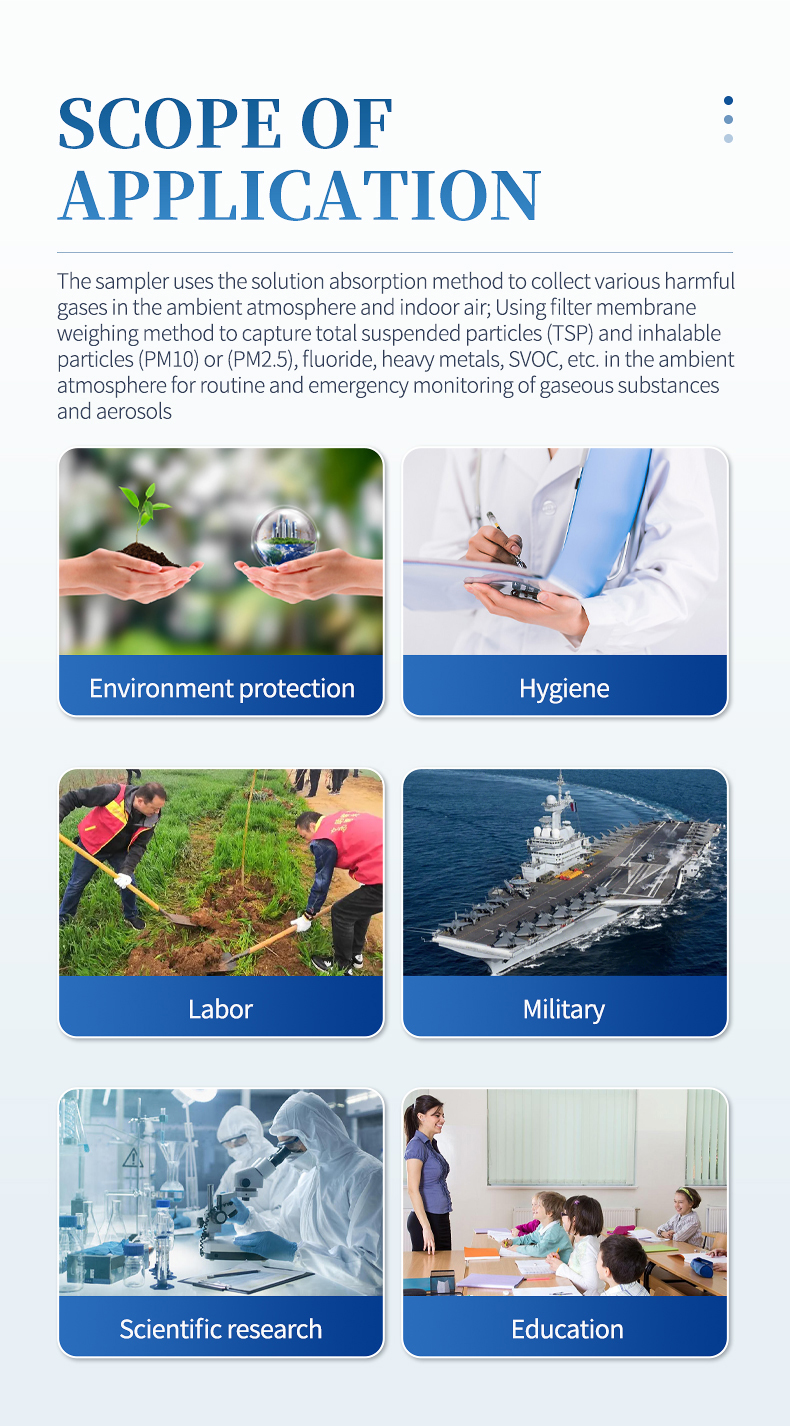
- Atmospheric chemistry research. Simultaneous collection of VOCs on sorbent tubes and particulates on filter substrates during field campaigns — correlate gas-phase and particle-phase concentrations from co-located samples.
- University environmental science programs. Single-instrument demonstration of multiple air sampling methods (absorption bottle, sorbent tube, filter-based particulate) within standard lab sessions without equipment changes.
- Indoor air quality investigations. Low-flow VOCs sorbent tube sampling combined with PM2.5 mass concentration measurement for comprehensive indoor environment characterization.
- Environmental impact baseline studies. Deploy the HM-H5 at pre-construction monitoring sites to collect multi-parameter baseline data meeting HJ 618-2011 and HJ 644-2013 requirements.
- Occupational hygiene screening. Micro-flow VOCs sampling for workplace exposure assessment alongside respirable particulate monitoring in industrial environments.
- Ambient air quality monitoring networks. Compact form factor and dual AC/DC power allow deployment at remote monitoring stations where space and power are limited.
Key Features & Advantages
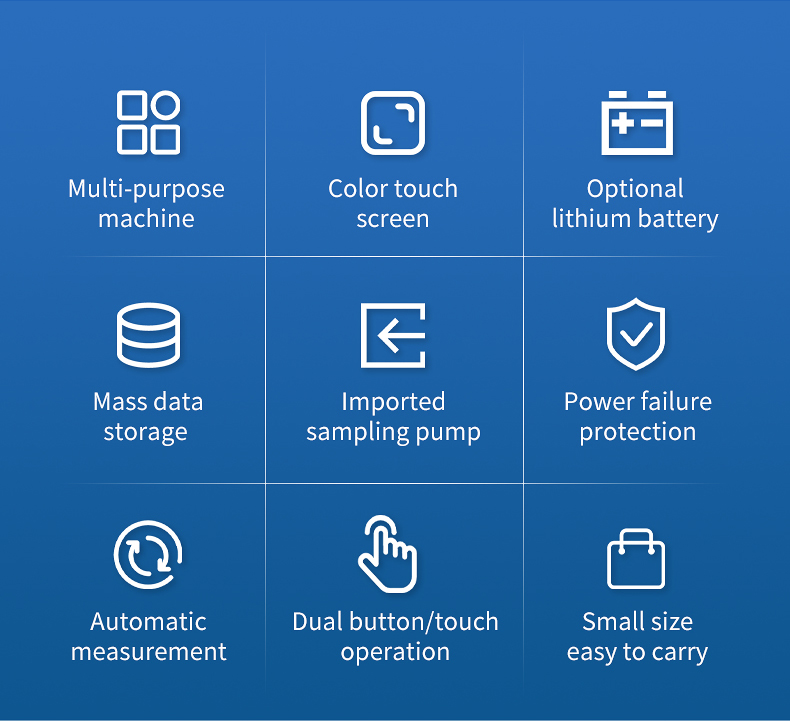
- Three independent channels in one instrument. Constant-temperature constant-flow, micro-flow constant-flow, and particulate channels operate simultaneously without mutual interference — replace three separate instruments.
- Dedicated VOCs sorbent tube micro-flow channel. 0.020–0.300 L/min range with ±2.0% accuracy matches the low-flow requirements of EPA TO-17, HJ 644-2013, and HJ 583-2010 methods.
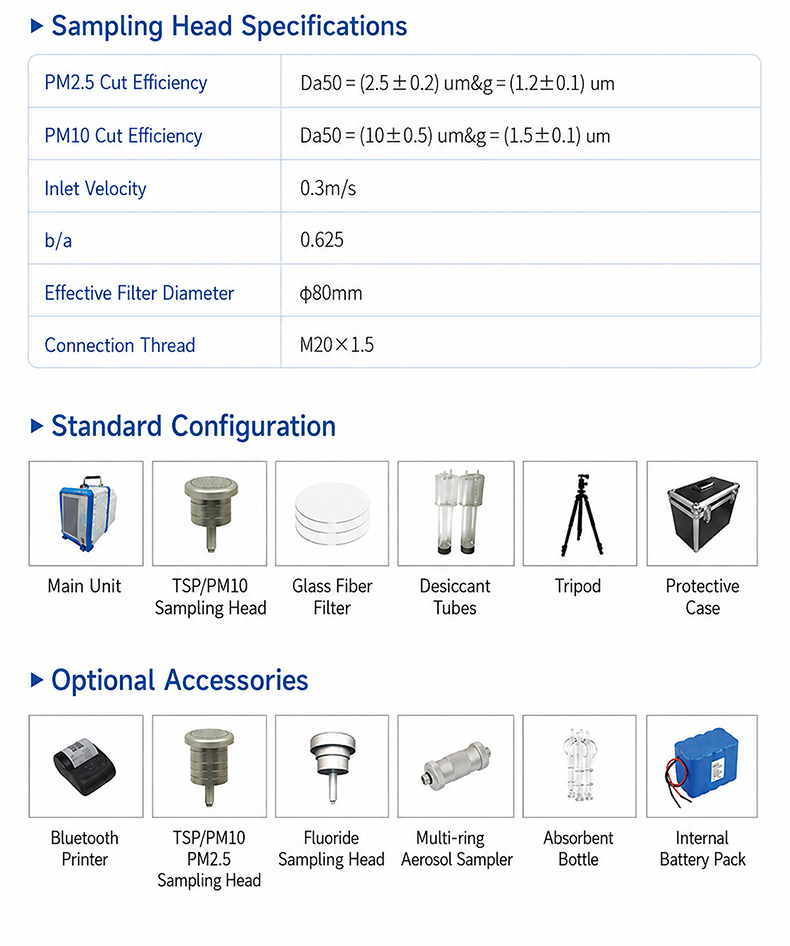
- Particulate sampling at 10–130 L/min. Compatible with TSP, PM10, and PM2.5 cutting heads for size-fractionated particle collection compliant with HJ 618-2011 and HJ 93-2026.
- Constant-temperature constant-flow for gaseous methods. Maintains stable absorption solution temperature for SO2, NOx, and other wet-chemistry sampling protocols.
- Flow stability better than ±2.0%. Ensures repeatable sample volumes across extended sampling periods, critical for concentration calculations and regulatory comparability.
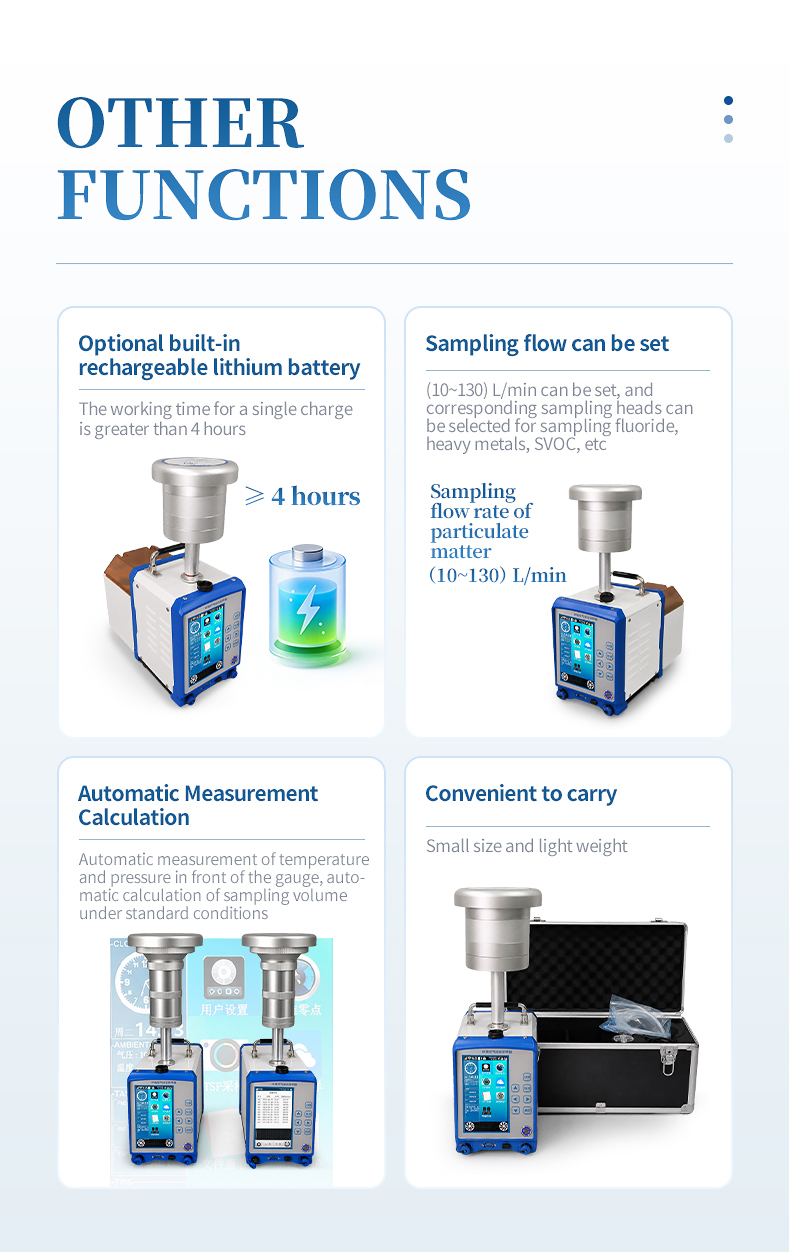
- Real-time standard-condition volume calculation. Automatic measurement of pre-gauge temperature, pre-gauge pressure, and atmospheric pressure eliminates post-sampling corrections and reduces data processing errors.
- Sampling time accuracy better than ±0.2%. Supports both short-duration grab sampling (1 min) and extended 24-hour monitoring (up to 99 h 59 min) with precise timing for concentration normalization.
- Low noise operation below 60 dB(A). Suitable for indoor classroom and laboratory use without disrupting teaching activities or residential-area monitoring.
- Dual AC/DC power supply. AC 220 V ±10% 50 Hz for laboratory bench operation; DC 29.4 V / 5 A for field deployments at locations without mains power access.
- Ultra-compact and lightweight. 165×330×275 mm and approximately 4.0 kg — one researcher can carry the instrument and accessories between monitoring points in a single trip.
- Power consumption below 100 W. Energy-efficient operation enables extended DC-powered sampling sessions from compact battery packs.
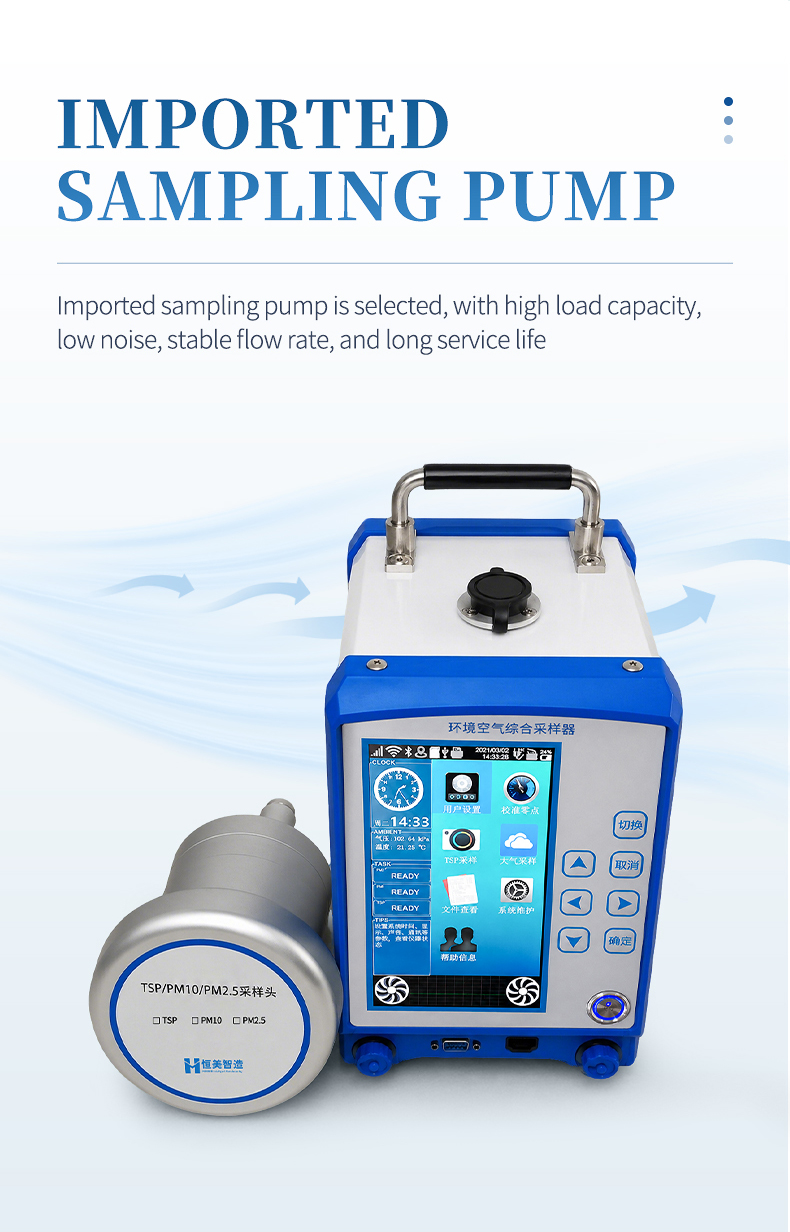
- Imported sampling pump. High load capacity, stable long-term flow output, and extended service life for multi-year research programs.
- Pre-gauge pressure range (-35 to 35 kPa). Wide pressure measurement range accommodates high-resistance sampling configurations including loaded filters and packed sorbent tubes.
- Atmospheric pressure measurement (50–110 kPa). Automatic barometric compensation ensures accurate standard-condition volume calculation at varying altitudes and weather conditions.
Technical Specifications
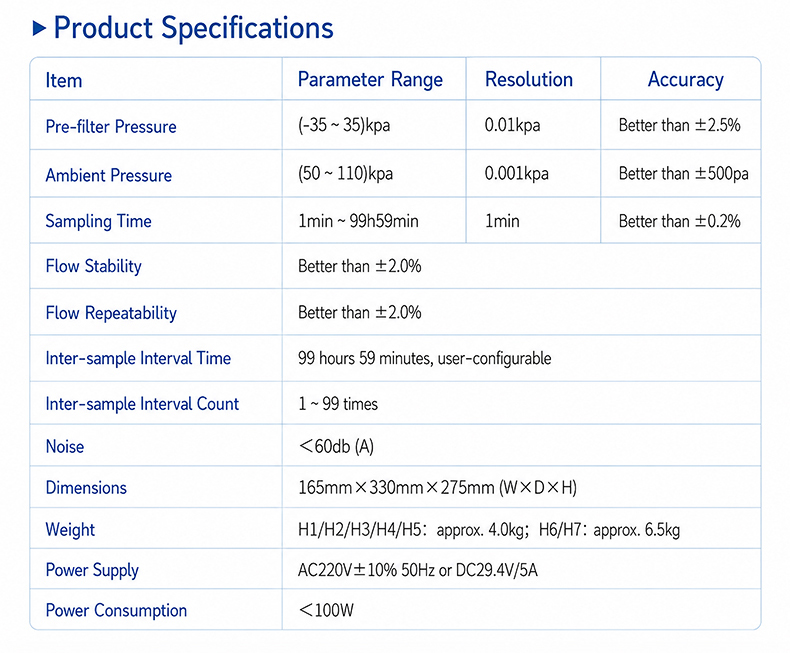
| Parameter | Range | Resolution | Accuracy |
|---|
| Particulate sampling flow | (10–130) L/min | 0.01 L/min | Better than ±2.0% |
| Micro-flow constant-flow | (0.020–0.300) L/min | 0.001 L/min | Better than ±2.0% |
| Flow stability | — | — | Better than ±2.0% |
| Pre-gauge pressure | (-35–35) kPa | 0.01 kPa | Better than ±2.5% |
| Atmospheric pressure | (50–110) kPa | 0.001 kPa | Better than ±500 Pa |
| Sampling time | 1 min – 99 h 59 min | 1 min | Better than ±0.2% |
| Noise | <60 dB(A) |
| Power supply | AC 220 V ±10% 50 Hz or DC 29.4 V / 5 A |
| Power consumption | <100 W |
| Dimensions (W×D×H) | 165 × 330 × 275 mm |
| Weight | Approx. 4.0 kg |
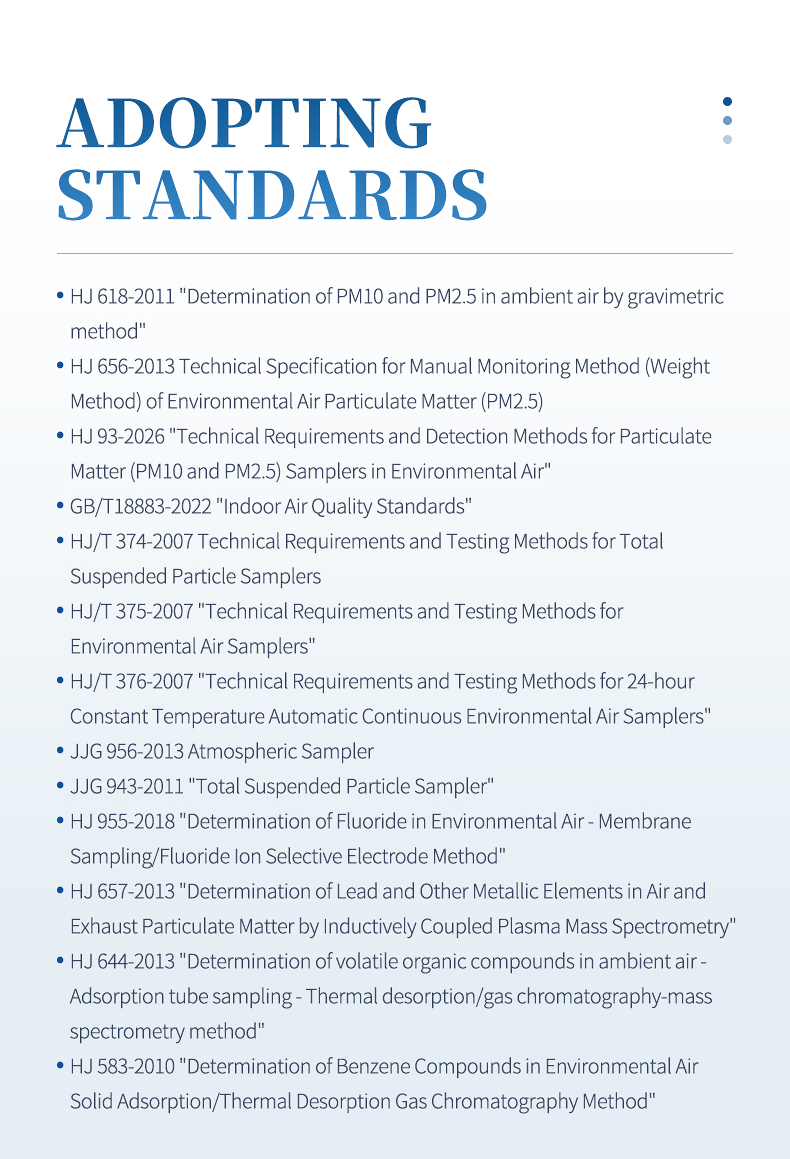
| Reference standards | HJ 618-2011, HJ 644-2013, HJ 583-2010, HJ 93-2026, HJ 656-2013 |
FAQ
Q: Can the HM-H5 simultaneously collect VOCs on sorbent tubes and particulates on filters?
A: Yes. The HM-H5 features three independently controlled sampling channels — constant-temperature constant-flow, micro-flow constant-flow (0.020–0.300 L/min), and particulate (10–130 L/min). All three channels operate simultaneously without cross-interference, allowing researchers to collect VOCs on sorbent tubes via the micro-flow channel while capturing PM10 or PM2.5 on filter substrates through the particulate channel in a single deployment. This eliminates the need for separate instruments and ensures that gas-phase and particle-phase samples are truly co-located in time and space, which is critical for atmospheric chemistry studies correlating VOCs and particulate concentrations.
Q: What flow rate range does the micro-flow channel support for VOCs sorbent tube sampling?
A: The micro-flow constant-flow channel operates at 0.020–0.300 L/min with accuracy better than ±2.0% and flow stability better than ±2.0%. This range covers the low-flow requirements specified in standard VOCs sampling methods such as EPA TO-17 (which typically uses 20–200 mL/min), HJ 644-2013 for ambient air VOCs, and HJ 583-2010 for benzene-series compounds. The channel maintains constant flow even as sorbent tube resistance increases during sampling, ensuring reliable breakthrough volume calculations.
Q: Is the HM-H5 suitable for university teaching laboratories with limited space and budget?
A: The HM-H5 is specifically well-suited for educational settings. Its compact 165×330×275 mm footprint takes up minimal bench space, and at approximately 4.0 kg it is easily moved between teaching labs or stored when not in use. At $971, it replaces the need for separate particulate samplers and gaseous pollutant sampling units, significantly reducing total equipment investment. The three independent channels allow students to observe and practice multiple air sampling methodologies — absorption bottle, sorbent tube, and filter-based particulate — using a single instrument within a standard lab session.
Q: How does the HM-H5 calculate standard-condition sampling volume?
A: The instrument automatically measures pre-gauge temperature, pre-gauge pressure, and atmospheric pressure in real time during sampling. Using these measured values, the HM-H5 continuously computes the standard-condition (101.325 kPa, 273.15 K) sampling volume rather than relying on separate post-sampling corrections. This real-time compensation accounts for changes in ambient conditions during extended sampling periods, improving data accuracy compared to methods that apply a single correction factor after sampling. The pre-gauge pressure measurement range of (-35–35) kPa accommodates the increased resistance from loaded filters and packed sorbent tubes.
Q: What power options are available for field deployments?
A: The HM-H5 supports dual power input: AC 220 V ±10% at 50 Hz for mains-powered laboratory or fixed-site operation, and DC 29.4 V / 5 A for battery-powered field campaigns. With power consumption below 100 W, the instrument can operate for extended periods from a compact 29.4 V lithium battery pack. This dual-power capability enables researchers to conduct indoor laboratory sessions and outdoor field measurements with the same instrument without purchasing additional power accessories or separate field-rated equipment.
Q: What standards does the HM-H5 comply with for ambient air sampling?
A: The HM-H5 is designed to meet the requirements of multiple Chinese and international ambient air sampling standards, including HJ 618-2011 (determination of PM2.5 and PM10 by gravimetric method), HJ 644-2013 (determination of VOCs in ambient air), HJ 583-2010 (determination of benzene-series compounds), HJ 93-2026 (specifications and test procedures for PM10 and PM2.5 samplers), and HJ 656-2013 (technical requirements for ambient air PM2.5 manual monitoring). The flow accuracy better than ±2.0% and sampling time accuracy better than ±0.2% support compliance with these methods' measurement uncertainty requirements.
Article address:
https://www.environmentinstrum.com/pro8/enhanced-air-sampler-vocs-research.html



 +86 17853698681